| |
|
|
Tribute to Handel's Messiah
|
|
|
|
|
|
|
|
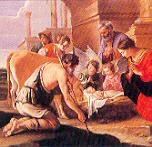
Handel's Messiah
George Frederic
Handel (1695-1759)
 PART ONE
: The prophesy and
realization of God's
plan to redeem mankind
by the coming of the
Messiah PART ONE
: The prophesy and
realization of God's
plan to redeem mankind
by the coming of the
Messiah
(1) Overture
Sinfony
(2) Comfort Ye
Recitative
(Tenor or
Soprano)
Comfort ye,
comfort ye my
people, saith your
God. Speak ye
comfortably to
Jerusalem, and cry
unto her, that her
warfare is
accomplished, that
her iniquity is
pardoned. The voice of
him that crieth in
the wilderness,
Prepare ye the way
of the Lord, make
straight in the
desert a highway
for our God.
(Isaiah 40:1-3)
(3) Every
Valley
Air
(Tenor or Soprano)
Every valley shall
be exalted, and every
mountain and hill made
low, the crooked
straight, and the
rough places plain.
(Isaiah 40:4)
(4)
And the Glory of the
Lord Chorus
And the glory of
the Lord shall be
revealed, and all
flesh shall see it
together: for the
mouth of the Lord hath
spoken it.
(Isaiah 40:5)
(5)
Thus saith the Lord
Recitative
(Bass)
Thus saith the
Lord, the Lord of
Hosts; Yet once a
little while and I
will shake the heav'ns
and the earth, the sea
and the dry land: And
I will shake all
nations; and the
desire of all nations
shall come.
(Haggai 2:6-7)
The Lord, whom ye
seek, shall suddenly
come to His temple,
even the messenger of
the Covenant, whom ye
delight in: behold, He
shall come, saith the
Lord of Hosts.
(Malachi 3:1)
(6)
But who may abide the
Day of His Coming?
Air (Alto or
Bass)
But who may abide
the day of His coming,
and who shall stand
when He appeareth? For
He is like a refiner's
fire.
(Malachi 3:2)
(7)
And He shall Purify
Chorus
And He shall
purify the sons of
Levi, that they may
offer unto the Lord an
offering in
righteousness.
(Malachi 3:3)
(8)
Behold A Virgin Shall
Conceive
Recitative
(Alto or Counter
Tenor)
Behold, a virgin
shall conceive and
bear a Son, and shall
call his name
Emmanuel, GOD WITH US.
(Isaiah 7:14;
Matthew 1:23)
(9)
O thou that tellest
good tidings to Zion
Air (Alto) &
Chorus
O thou that
tellest good tidings
to Zion, get thee up
into the high
mountain. O thou that
tellest good tidings
to Jerusalem, lift up
thy voice with
strength; lift it up,
be not afraid; say
unto the cities of
Judah, behold your
God! O thou that
tellest good tidings
to Zion, (Isaiah
40:9)
Arise, shine, for
thy Light is come, and
the glory of the Lord
is risen upon thee.
Isaiah 60:1)
(10) For
behold, darkness
shall cover the
earth
Recitative
(Bass)
For behold,
darkness shall cover
the earth, and gross
darkness the people;
but the Lord shall
arise upon thee, and
His glory shall be
seen upon thee. And
the Gentiles shall
come to thy light, and
kings to the
brightness of thy
rising.
(Isaiah 60:2-3)
(11)
The people that walked
in darkness
Air (Bass)
The people that
walked in darkness
have seen a great
light; and they that
dwell in the land of
the shadow of death,
upon them hath the
light shined.
(Isaiah 9:2)
(12) For unto Us a
Child is born
Chorus
For unto us a
Child is born, unto us
a Son is given, and
the government shall
be upon His shoulder;
and His name shall be
called Wonderful,
Counsellor, the Mighty
God, the Everlasting
Father, the Prince of
Peace.
(Isaiah 9:6)
(13) Pastoral
Symphony
(Pifa)
(14) There were
shepherds abiding
in the field
Recitative
(Soprano)
There were
shepherds abiding in
the field, keeping
watch over their
flocks by night.
(Luke 2:8)
(15) And
lo, the angel of the
Lord came upon them
Recitative
(Soprano)
And lo, the angel
of the Lord came upon
them, and the glory of
the Lord shone round
about them, and they
were sore afraid.
(Luke 2:9)
(16)
And the
Angel said unto
them
Recitative
(Soprano)
And the angel said
unto them: Fear not,
for behold, I bring
you good tidings of
great joy, which shall
be to all people. For
unto you is born this
day in the city of
David a Saviour, which
is Christ the Lord.
(Luke 2:10-11)
(17) And
suddenly there was
with the Angel
Recitative
(Soprano)
And suddenly there
was with the angel, a
multitude of the
heavenly host,
praising God, and
saying:
(Luke 2:13)
(18) Glory to
God
Chorus
Glory to God in
the highest, and peace
on earth, good will
towards men.
(Luke 2:14)
(19) Rejoice
greatly, O
Daughter of Zion
Air (Soprano
or Tenor)
Rejoice greatly, O
daughter of Zion;
shout, O daughter of
Jerusalem! Behold, thy
King cometh unto thee;
He is the righteous
Saviour, and He shall
speak peace unto the
heathen.
(Zecharaiah 9:9-10)
(20) Then shall
the eyes of the
blind
Recitative
(Soprano or Alto)
Then shall the
eyes of the blind be
opened, and the ears
of the deaf unstopped.
Then shall the lame
man leap as an hart,
and the tongue of the
dumb shall sing.
(Isaiah 35:5-6)
(21) He shall
feed his flock
like a shepherd
Aria (Soprano
or Alto)
He shall feed His
flock like a shepherd;
and He shall gather
the lambs with His
arm, and carry them in
His bosom, and gently
lead those that are
with young.
(Isaiah 40:11)
Come unto Him, all
ye that labour, come
unto Him that are
heavy laden, an He
will give you rest.
Take His yoke upon
you, and learn of Him,
for He is meek and
lowly of heart, and ye
shall find rest unto
your souls.
(Matthew 11:28-29)
(22) His yoke
is easy
Chorus
His yoke is easy,
and his burden is
light.
(Matthew 11:30)
PART TWO : The
accomplishment of
redemption by the
sacrifice of Jesus,
mankind's rejection of
God's offer, and
mankind's utter defeat
when trying to oppose
the power of the
Almighty
(23) Behold the
lamb of God
Chorus
Behold the Lamb of
God, that taketh away
the sin of the world.
(John 1:29)
(24) He was
despised
Air (Alto or
Counter Tenor)
He was despised
and rejected of men, a
man of sorrows and
acquainted with grief.
(Isaiah 53:3)
He gave His back
to the smiters, and
His cheeks to them
that plucked off the
hair: He hid not His
face from shame and
spitting.
(Isaiah 50:6)
(25) Surely He
hath borne our griefs
Chorus
Surely He hath
borne our griefs, and
carried our sorrows!
He was wounded for our
transgressions, He was
bruised for our
iniquities; the
chastisement of our
peace was upon Him.
(Isaiah 53:4-5)
(26) And with
His stripes we are
healed
Chorus
And with His
stripes we are healed.
(Isaiah 53:5)
(27) All we
like sheep have
gone astray
Chorus
All we, like
sheep, have gone
astray; we have turned
every one to his own
way, and the Lord hath
laid on Him the
iniquity of us all.
(Isaiah 53:6)
(28) All they
that see him laugh
him to scorn
Recitative
(Tenor or Soprano)
All they that see
Him laugh Him to
scorn; they shoot out
their lips, and shake
their heads, saying:
(Psalms 22:7)
(29) He trusted
in God
Chorus
He trusted in God
that He would deliver
Him; let Him deliver
Him, if He delight in
Him.
(Psalms 22:8;
Matthew 27:43)
(30) Thy rebuke
hath broken His
heart
Recitative (Tenor or
Soprano)
Thy rebuke hath
broken His heart: He
is full of heaviness.
He looked for some to
have pity on Him, but
there was no man,
neither found He any
to comfort Him.
(Psalms 69:20)
(31) Behold,
and see if there
be any sorrow
Arioso (Tenor or
Soprano)
Behold, and see if
there be any sorrow
like unto His sorrow.
(Lamentations 1:12)
(32) He was cut
off out of the
land of the living
Recitative
(Tenor or Soprano)
He was cut off out
the land of the
living: for the
transgressions of Thy
people was He
stricken.
(Isaiah 53:8)
(33) But Thou
didst not leave
His soul in hell
Air (Tenor
or Soprano)
But Thou didst not
leave His soul in
hell; nor didst Thou
suffer Thy Holy One to
see corruption.
(Psalms 16:10;
Acts 2:27)
(34) Lift up
your heads, O ye
gates
Chorus
Lift up your
heads, O ye gates; and
be ye lift up, ye
everlasting doors; and
the King of Glory
shall come in. Who is
this King of Glory?
The Lord strong and
mighty, the Lord
mighty in battle. Lift
up your heads, O ye
gates; and be ye lift
up, ye everlasting
doors; and the King of
Glory shall come in.
Who is this King of
Glory? The Lord of
Hosts, He is the King
of Glory.
(Psalms 24:7-10)
(35) Unto which
of the angels said
He at any time
Recitative (Tenor
or Soprano)
Unto which of the
angels said He at any
time: Thou art My Son,
this day have I
begotten Thee?
(Hebrews 1:5;
Psalm 2:7)
(36) Let all
the angels of God
worship Him
Chorus
Let all the angels
of God worship Him.
(Hebrews 1:6)
(37) Thou art
gone up on high
Air (Alto or Bass)
Thou art gone up
on high; Thou hast led
captivity captive, and
received gifts for
men; yea, even from
Thine enemies, that
the Lord God might
dwell among them.
(Psalms 68:18;
Ephesians 4:8)
(38) The Lord
gave the word
Chorus
The Lord gave the
word; great was the
company of the
preachers.
(Psalms 68:11)
(39) How
beautiful are the
feet
Air
(Soprano or Counter
Tenor)
How beautiful are
the feet of them: that
preach the gospel of
peace, and bring glad
tidings of good
things.
(Romans 10:15;
Isaiah 52:7)
(40) Their
sound is gone out
Chorus
Their sound is
gone out into all
lands, and their words
unto the ends of the
world.
(Romans 10:18;
Psalms 19:4)
(41) Why do the
nations so
furiously rage
together?
Air (Bass)
Why do the nations
so furiously rage
together, and why do
the people imagine a
vain thing? The kings
of the earth rise up,
and the rulers take
counsel together
against the Lord, and
against His Anointed.
(Psalms 2:1-2;
Acts 4:25-26)
(42) Let us
break their bonds
asunder
Chorus
Let us break their
bonds asunder, and
cast away their yokes
from us.
(Psalms 2:3)
(43) He that dwelleth in heaven
Recitative (Tenor)
He that dwelleth
in heaven shall laugh
them to scorn; the
Lord shall have them
in derision.
(Psalms 2:4)
(44) Thou shalt
break them
Air (Tenor)
Thou shalt break
them with a rod of
iron; thou shalt dash
them in pieces like a
potter's vessel.
(Psalms 2:9)
(45) Hallelujah
Chorus
Hallelujah! for
the Lord God
Omnipotent reigneth.
(Revelation 19:6)
The kingdom of
this world is become
the kingdom of our
Lord, and of His
Christ; and He shall
reign for ever and
ever.
(Revelation 11:15)
King of Kings, and
Lord of Lords.
(Revelation 19:16)
Hallelujah!
PART THREE : A
Hymn of Thanksgiving
for the final
overthrow of Death
(46) I know that
my redeemer liveth
Air (Soprano)
I know that my
Redeemer liveth, and
that he shall stand at
the latter day upon
the earth. And though
worms destroy this
body, yet in my flesh
shall I see God.
(Job 19:25-26)
For now is Christ
risen from the dead,
the first fruits of
them that sleep.
(I Corinthians 15:20)
(47) Since by
man came death
Chorus
Since by man came
death, by man came
also the resurrection
of the dead. For as in
Adam all die, even so
in Christ shall all be
made alive.
(I Corinthians 15:21-22)
(48) Behold I
tell you a mystery
Recitative
(Bass)
Behold, I tell you
a mystery; we shall
not all sleep, but we
shall all be changed
in a moment, in the
twinkling of an eye,
at the last trumpet.
(I Corinthians 15:51-52)
(49) The
trumpet shall
sound
Air (Bass)
The trumpet shall
sound, and the dead
shall be raised
incorruptible, and we
shall be changed. For
this corruptible must
put on incorruption
and this mortal must
put on immortality.
(I Corinthians 15:52-53)
(50) Then shall
be brought to pass
Recitative (Alto
or Counter Tenor)
Then shall be
brought to pass the
saying that is
written: Death is
swallowed up in
victory.
(I Corinthians 15:54;
Isaiah 25:8)
(51) O death
where is thy
sting?
Duet
(Alto/Tenor/Counter
Tenor)
O death, where is
thy sting? O grave,
where is thy victory
The sting of death is
sin, and the strength
of sin is the law.
(I Corinthians 15:55-56;
Hosea 13:14)
(52) But thanks
be to God
Chorus
But thanks be to
God, who giveth us the
victory through our
Lord Jesus Christ.
(I Corinthians 15:57)
(53) If God be
for us
Air (Soprano or
Contralto)
If God be for us,
who can be against us?
(Romans 8:31)
Who shall lay
anything to the charge
of God's elect? It is
God that justifieth,
who is he that
condemneth? It is
Christ that died, yea
rather, that is risen
again, who is at the
right hand of God, who
makes intercession for
us.
(Romans 8:33-34)
(54) Worthy is
the Lamb
Chorus
Worthy is the Lamb
that was slain, and
hath redeemed us to
God by His blood, to
receive power, and
riches, and wisdom,
and strength, and
honour, and glory, and
blessing. Blessing and
honour, glory and
power, be unto Him
that sitteth upon the
throne, and unto the
Lamb, for ever and
ever. Amen.
(Revelation 5:12-13) |
|
|
|
|
|
|
|
|


 Music Page
 One of the earliest
musical influences on the composer of Bible in Song
music was Handel's Messiah, particularly the fact that
it is possible to write melodic tunes to actual
Scripture.
One of the earliest
musical influences on the composer of Bible in Song
music was Handel's Messiah, particularly the fact that
it is possible to write melodic tunes to actual
Scripture. All Creatures of Our God and King